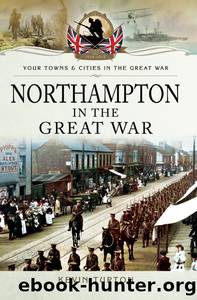
Northampton in the Great War by Kevin Turton
Author:Kevin Turton [Turton, Kevin]
Language: eng
Format: epub
Tags: Nonfiction, History, Military, World War I
ISBN: 9781473873629
Publisher: Pen & Sword Books
Published: 2016-05-30T04:00:00+00:00
Zeppelin caught in the searchlights.
With fines ranging from around 10 shillings (50p) to one pound and the courts having the latitude to increase the level, it was to prove costly for some. But when the air-raid sirens sounded at 9pm on 31 January, as the first major Zeppelin raid of the war began, many realised the merit of total darkness. Across Northampton every street light was extinguished. Gas pressures were lowered, all trains were stopped, traffic on all roads brought to a halt and cinemas and theatres quickly closed. Unfortunately, the sound of engines high above the town also brought people out onto the streets, curiosity being the main reason for coming out on a cold night. For the sake of safety, police reacted by sending out an additional fifty special constables. According to Bette Davis, writing many years after the event:
There was nothing to be seen really. Just the noise and that was far off from where we were stood. But people were really excited. Course we had no idea about bombs and suchlike.
Twenty-four hours later they knew all too well. News reports circulated about the destruction that had caused the deaths of fifty-nine men, women and children across the east coast, Lincolnshire, Leicestershire, Derbyshire and Staffordshire, along with 101 wounded after 300 bombs were dropped. Dimming the lights after that probably seemed a small price to pay for safety.
Bombing, of course, would become more frequent in parts of the country as the war progressed, and like many other aspects of this war, people would grow more used to it. By March, fear of it had already begun to fade into the background. More newsworthy by far was the growing number of what were often termed âconscientious objectorsâ appearing before the appeals tribunal held at Northamptonâs County Hall. At this stage of the war the term conscientious objector, widely used by the local press, did have a slightly different connotation than it would have later. In March 1916, the term tended to always be applied to a serving soldier who had enlisted then refused to take up arms. These men faced a court-martial, often held at the church institute in Kingsthorpe. Civilians, often classified under the same heading, were generally individuals who had joined the Derby Scheme at the end of 1915, but then wanted to opt out as the army called them into service. These men were brought before an appeals tribunal to argue their case against enlistment. Generally, this was on the grounds of performing work of national importance or, through family hardship. This began to change after the Conscription Act had become law in late March. The Act included a conscience clause whereby any man who had a conscientious objection to bearing arms could be freed from military service. So the panel that sat in judgement from that time onward had a different intent from its predecessor. These panels, made up largely of businessmen, retired military officers, civil servants and always one serving army officer, were hugely patriotic with, of course, one remit â fill the depleted ranks with more men.
Download
This site does not store any files on its server. We only index and link to content provided by other sites. Please contact the content providers to delete copyright contents if any and email us, we'll remove relevant links or contents immediately.
| Africa | Americas |
| Arctic & Antarctica | Asia |
| Australia & Oceania | Europe |
| Middle East | Russia |
| United States | World |
| Ancient Civilizations | Military |
| Historical Study & Educational Resources |
Room 212 by Kate Stewart(5185)
The Crown by Robert Lacey(4867)
Endurance: Shackleton's Incredible Voyage by Alfred Lansing(4847)
The Iron Duke by The Iron Duke(4408)
The Rape of Nanking by Iris Chang(4265)
Joan of Arc by Mary Gordon(4158)
Say Nothing by Patrick Radden Keefe(4048)
Killing England by Bill O'Reilly(4043)
I'll Give You the Sun by Jandy Nelson(3498)
Shadow of Night by Deborah Harkness(3412)
Hitler's Monsters by Eric Kurlander(3388)
Blood and Sand by Alex Von Tunzelmann(3242)
Mary, Queen of Scots, and the Murder of Lord Darnley by Alison Weir(3241)
Eleanor & Park by Rainbow Rowell(3239)
Darkest Hour by Anthony McCarten(3162)
Margaret Thatcher: The Autobiography by Thatcher Margaret(3113)
Book of Life by Deborah Harkness(2986)
Red Famine: Stalin's War on Ukraine by Anne Applebaum(2972)
The One Memory of Flora Banks by Emily Barr(2900)
